
Single-engine
Personal jets
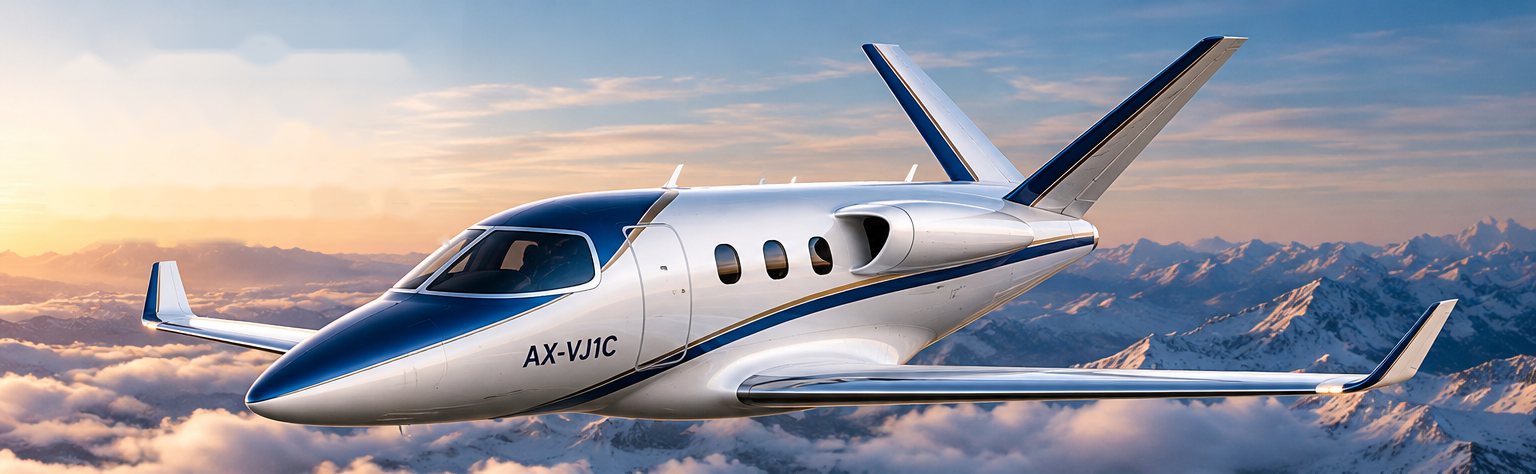
Aircraft like the Cirrus Vision SF50, flown mostly by their owners. Simplicity, safety systems and low running costs matter most.
About us
We design engines for the smallest jets in the sky, and we help engine makers get more out of the engines they already have.
Who we are
Axiom Turbine is a design partner for small turbofan engines. Some clients come to us with a new engine to design. Others bring an engine that already flies and want it lighter, more efficient or better at altitude. We have worked through both, on very light jets and on a light regional cargo jet.
We always start at the front of the engine. The fan and the low-pressure booster, which we design together as one low-pressure module (LPM), decide most of what a small engine can do at altitude. We tune it for each of our own engines, and for the designs still to come.
Our team is small and focused. Between us we have designed, built and tested gas turbines, from small jet engines to 100–200 kW power units, and we have flown the kind of aircraft these engines are made for. We also work with production facilities that can make parts this demanding.
Behind the team sits our Smart Design System. We built it from years of work in aerodynamics and turbomachinery. It gets a little better with every project.
The market
A very light jet is the smallest class of jet aircraft. It usually flies with one pilot, carries four to seven people and weighs under about 4,500 kg (10,000 lb) at take-off. It sits between the fast turboprop single and the larger light business jet.
Single-engine
Aircraft like the Cirrus Vision SF50, flown mostly by their owners. Simplicity, safety systems and low running costs matter most.
Twin-engine
Aircraft like the Embraer Phenom 100, the HondaJet and the Cessna Citation Mustang, flown by owners, charter operators and companies.
Both rely on a small group of turbofans of about 4–9 kN, built by a handful of established manufacturers.
History
NASA's Small Aircraft Transportation System pictured jets flying from the small airfields airlines ignore. About 10,000 of the 14,000 US airfields were shorter than 4,000 ft, and 3,000 ft strips were within half an hour of 93% of Americans. Engine makers started on turbofans of 4–6.7 kN, and forecasts spoke of 4,000 very light jets in 15 years.
The Cessna Citation Mustang and the Eclipse 500 received their FAA type certificates.
The financial crisis hit. Air-taxi operators who had ordered aircraft by the hundred could not make the numbers work, Eclipse Aviation went bankrupt in November 2008, and many paper designs never flew. The lesson: a small jet has to be built well, supported well and powered by an engine that is truly economical.
The Phenom 100 was certified in December 2008 and the HondaJet in December 2015. In 2016 the single-engine Vision SF50 opened the personal-jet market.
Emergency Autoland arrived on the Vision Jet in 2020 and on the HondaJet Elite II in early 2026. Owners now expect airline-level safety, and they compare every jet with the running costs of a good turboprop.
What is changing
10–15%LIGHTER COMPOSITE FUSELAGE
Carbon fibre is replacing aluminium. HondaJet's engineers found it cut fuselage weight by 10–15%, and a stiffer cabin can fly higher, where the air is thinner and drag is lower.
3.16 kgCO₂ PER KG OF JET FUEL
Every kilogram of fuel an engine saves keeps 3.16 kg of CO₂ out of the air, the figure ICAO uses for emissions reporting. Burn less and you emit less, one for one.
≈100 kgONE SEAT, ONE PILOT
Emergency Autoland can land the aircraft if the pilot cannot. It is a safety system, not a co-pilot, but it gives owners the confidence to fly alone and use the second seat for fuel or a passenger.
What this asks of the engine. A lighter jet that flies higher and further with one pilot needs an engine that keeps its thrust above 40,000 ft, burns as little as possible up there and stays steady in thin, cold air.
What operators ask for
Small engines are hard to get right. There is less metal to carry heat away, and the gaps at the blade tips matter more as the engine shrinks. Every percent of efficiency has to be earned.
When one engine stops. Twin-jet pilots train for an engine failure at the worst moment: just after take-off, or high over the sea at night. The other engine then has to climb the aircraft away and hold it at a safe height. The less thrust it keeps at altitude, the lower that height and the longer the descent into weather. That is why we design for strong thrust up high and a generous surge margin at full power.
Why we do it
We believe the next great small jet engine will come from patient, careful engineering that respects the physics and listens to pilots. If you feel the same, we would like to hear from you.
Email us info@axiomturbine.com